
Project-Based Learning (PBL) –
- Is a student-centered and experimental approach to education promoting ‘deeper learning’ through active exploration of real-world problems and challenges.
- Engages students in the problem definition, design process, contextual understanding and systems thinking approaches.
- Includes a few hands-on activities that may be multidisciplinary.
- Use of technology in meaningful ways to help them investigate, collaborate, analyze, synthesize and present their learning.
- Activities of PBL will be based on solving real-life problems, investigation /study and writing reports of in-depth study and fieldwork.
Objectives of PBL
- Impart technical knowledge and skills, and develop a deeper understanding to integrate knowledge and skills from various areas.
- Build critical thinking, problem-solving, communication, collaboration, creativity, and innovation amongst students.
- Make students aware of their own academic, personal, and social developments.
- Develop habits of self-evaluation and self-criticism, against self-competency and trying to see beyond one’s own ideas and knowledge.
Number of PBL Projects for Last 4 Academic Years
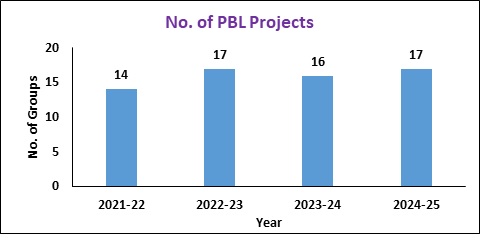
Few Remarkable Projects for Last 4 Academic Years
| Academic Year | No. Of PBL Projects /Groups | Title of The Project |
| AY 2024-25 | Ishaan Kshirsagar Anurag Madiwale Aniket Muley Sushma Mandle Shruti Parkhe |
Transmission Line Fault Detector System |
| Kaustubh Nalawade Varad Mogle Om Nanaware Mukesh Mahale Snehal Mane |
Free Vortex Hydro Turbine | |
| Pranay Chavan Nikhil Attarde Raghav Fanje |
Smart Dustbin | |
| Vedant Charegaonkar Sukrut Angal Atharva Karanjawane (AI&DS) Bhagyashri Bharati (EnTc) Parth Deokar (AI&DS) |
AI-Powered System that Optimizes Renewable Energy, Energy Storage, Load Balancing, Distribution, Ensuring Efficient and Sustainable Energy Management | |
| AY 2023-24 | Rohan Ghadage Vaibhav Kamble Akash Gawade Sufiya Patel |
Demonstration of RMF of three phase induction motor |
| Shantanu Rajesh Yadav Niraj S. Somvanshi Prabhakar Arun Bhosale Abhishek Biru Ghodake |
Development of coil winding machine | |
| Siddhesh Supugade Pooja Ambardekar Tanvi Patil Isha Gokhale |
Prototype of sewage monitoring system | |
| Arkam Bagwan Pooja Kamble Manaswi Zirange Narendra Zungare Tejas Malode |
Smart bus ticket system | |
| AY 2022-23 | Garud Prachi Damami Pratik Salunkhe Kalyani Garje Samrudhi |
Wireless Sound Transmission using Light Technology |
| Rucha Kulkarni Manaswi Zirange Ishani Jadhav Shreyas Jagtap Aditya Pandit Narendra Zurngare |
Energy Conservation by Automatic Light Control Using Motion Sensors | |
| Kokate Atharva Otari Atharva Rasal Soham Solat Abhijeet |
DC Motor Speed Regulation Using Temperature Sensor With the Help of Arduino | |
| Mandlik Aditya Gavhane Sweekar Aga Aman Usman Salgaonkar Shruti Kharmale Gayatri |
Solar Power Based USB/Mobile Charger | |
| AY 2021-22 | Anurag Lad Harsh Deshpande Abhijit Bhadane Swaliha Mujawar Adityawardhan Sabnis |
Home Automation |
| Sakshi Paitwar Harshal Kolthe Abhishek Gaware Vaishnavi Kandekar Rupali Padekar Simran Bankar |
Wireless Notice Board | |
| Avadhut Mangave Aditya Nagargoje Sanket Agarwal Umesh Umarani Vikrant Ganesh Gujar |
Digital Tachometer using IR sensor | |
| Harshwardhan Thorat Mahamadali Mursal Prasad Deshmukh Mohit Kudgi Abhishek Pawar Sakib Attar |
LED Distance Indicator |
Photos of PBL Orientation

Photos of PBL Practical

Methodology /Process of PBL
- Flexibility for making group of students as per area of interest within the practical batch OR (Roll No.1-5, 6-10).
- List of Ideas/Problem Statements from Students and Mentors (Min 2-3 Ideas/ Problem Statements).
- Faculty/Mentors will check out the feasibility of the ideas and, accordingly, Problem Statements will be finalized and defined by 2-3 Mentors after the student’s presentation.
- Once the idea is finalized, students start working on that idea in a team of 4-5 students.
- Every week, two practical slots are allotted to them, and they have to work on a PBL project during that period under the guidance of mentors.
- During the semester, two/ three reviews are taken by mentors for continuous assessment of the work.
- The students have to maintain the PBL Record Book, which will be monitored by mentors for continuous assessment.
- After completion of the project, students have to present/demonstrate their ideas to the review committee.
Photo of PBL Reviews
The final Reviews of PBL projects are carried out by renowned alumni and industry experts

 ACAP Round PCM Final Merit List (2026-27)
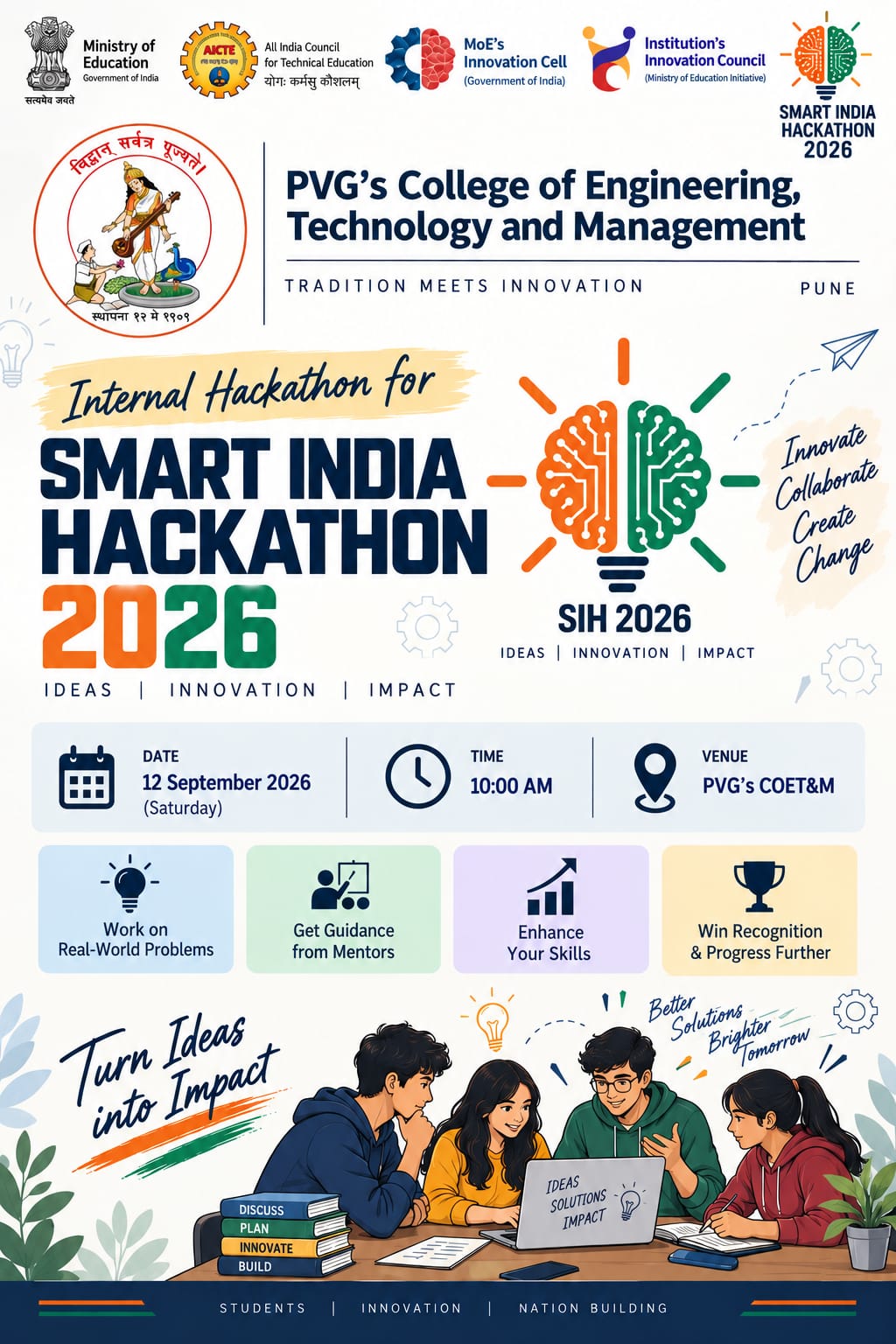 Internal Hackathon organized for SIH 2026.